
Food sustainability
A legal perspective on sustainability in the agri-food chain.

The research concerns legal areas such as constitutional, administrative, international, European Union, public comparative, tax and ecclesiastical law and economic policy. It is aimed at promoting a reflection, mostly of legal nature, regarding the concept of sustainability of the agri-food chain, in the absence of a shared definition. This topic is developed considering multiple research areas:
a) Sustainability as key concept of 21st century constitutionalism, seeking a synthesis between the ecological challenge and the social and economic issues of globalisation. The Agenda 2030 as a first expression of a global ‘sustainable’ constitutionalism;
b) impact of production processes and energy sustainability of the agri-food chain on the environment;
c) promotion of production models and sustainable consumption, with an eye to reducing food waste;
d) right to culturally appropriate food also in terms of religion and multiculturalism;
e) sustainable labelling, also regarding the behavioural effects related to the content of sustainable food labels;
f) right to food and food as commodity, and concepts of food security and their evolutions in times of crisis (pandemic, conflicts, climate change);
g) animal welfare;
h) right and limits to the promotion of sustainable food life styles;
i) models and policies to fight against food waste.
CORDINATOR: Laura Pineschi
MEMBERS: Anello Giancarlo, Bergamaschi Nicola, Bianchi Lorenzo, Brignoli Nicola, Carpanelli Elena, Cattani Luca, Cerbone Chiara, Comelli Alberto, Condemi Valerio, Corazza Maria Giulia, D'Aloia Antonio, Degli Antoni Giacomo, Di Lullo Ludovica, Errigo Maria Chiara, Ferri Pierfrancesco, Finocchiaro Antonino, Formici Giulia, Grilli Maria Laura, Inglese Marco, Maffei Maria Clara, Maio Emanuela, Mendillo Mario, Mileo Marica, Paganizza Valeria, Pitto Simone, Romano Luca, Rosanò Alessandro, Scaffardi Lucia, Scalcon Elena, Selleri Carlotta, Torretta Paola, Trombetta Panigadi Francesca, Valenti Veronica, Vetrò Francesco
MOOC
Among its main objectives, the F4F project aims to foster a renewed dialogue between the University and civil society. To this end, the Food Sustainability research group has developed its first MOOC (Massive Open Online Course), consisting of six lessons, as an innovative tool for the dissemination of knowledge and the engagement of the broader community on issues related to food sustainability.
Lesson n.1: Climate change, food sustainability and human rights - Prof. Elena Carpanelli
.jpg)
Lesson n. 2: Food sustainability and global health law - Dott.ssa Ludovica Di Lullo
Lesson n. 3: Food sustainability and the common agricultural policy - Dott. Alessandro Rosanò
Lesson n. 4: Food sustainability in the EU trade agreements - Dott. Nicola Bergamaschi
Lesson n. 5: International law and food loss and waste - Dott. Luca Romano
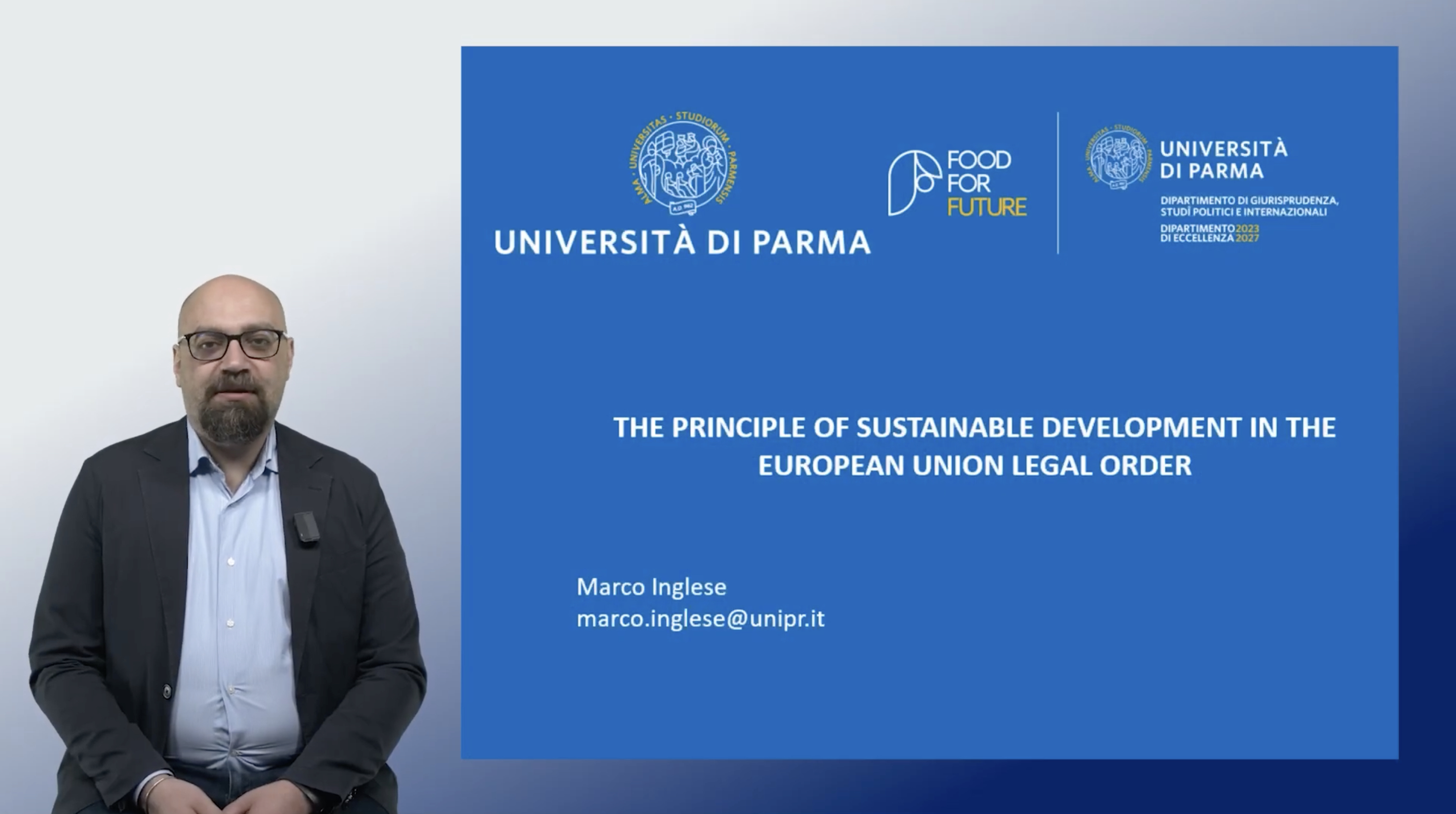
Lesson n. 6: The principle of sustainable development in the euoropean union legal order - Prof. Marco Inglese